
Skip to content

Posts appearing in 1st home page grid

Dealing with conflict

Conflict Is Inevitable

Conflicts are an inevitable part of life on the inhabited worlds, especially those in the early stages of social evolution—like Urantia. Nonetheless, despite millennia of confusion and hostility, many things have improved on this world, and they will continue to improve over time (see Factfulness by Hans Rosling). But not until the far distant future, when our planet finally attains the utopian ages of light and life, will we be entirely free of discord. This is not to say that, at such a time, all of us will agree, only that the manner in which we deal with our differences will be significantly improved.

Until we reach that utopia, and apart from impending warfare, we will experience two personal spheres of conflict—one in the inner life (mind, soul) and the other in the outer life (family, social, national).

Managing Inner Conflict

Jesus said there are two realms of human life: one is a life in the flesh, and the other is a life in the spirit. Indeed, on his return from Rome, he told Ganid that there are two great classes of mortals—those who know God and those who do not (133:0.3).

He went on to say that people who live completely in the flesh or completely in the spirit experience little inner conflict, but for all others who struggle to make the transition from one life to the next, there is a considerable degree of conflict and confusion along the way. And Jesus, rather than telling his disciples to ignore this struggle or to cover it up with false optimism, instead instructed them to be right up front about it.

Forewarn all believers regarding the fringe of conflict which must be traversed by all who pass from the life as it is lived in the flesh to the higher life as it is lived in the spirit. (159:3.7)

When I first read this section of The Urantia Book, I couldn’t help but think it was already difficult enough to spread Jesus’ essential and elementary message—that our spiritual life begins by accepting that we are children of God. And now we are advised to tell all prospective believers that achieving a spiritual life will entail much struggle and conflict. It seems like a hard sell.

Jesus said even more on this subject:

While you will experience great joy in the service of my Father, you should also be prepared for trouble, for I warn you that it will be only through much tribulation that many will enter the kingdom. (137:6.5)

The religion of the spirit means effort, struggle, conflict, faith, determination, love, loyalty, and progress. (155:5.11)

If you dare to believe in me and wholeheartedly proceed to follow after me, you shall most certainly, by so doing, enter upon the sure pathway to trouble. (159:3.13)

Our Master makes it clear that we can expect much tribulation and conflict in our ongoing efforts to minister to others and to live and prosper in the spirit. Throughout all this, we are also expected to accept our responsibilities and obligations to God, our families, and our communities.

The notion that a spiritual life is full of adversity and obligation is a far cry from fashionable views—that a spiritual journey is akin to “a fantastic and mystic experience of indescribable feelings of ecstasy” (101:1.1) or that it’s a mental state of utopian bliss.

Jesus dispelled many of our cherished notions. In the Roman Empire of those days, and even in the modern society of today, it was not uncommon for the faithful to believe they were entitled to divine providence or special treatment, or perhaps, by God’s hand, they would be spared the troubles of others. But this is never the case.

Teach all believers that those who enter the kingdom are not thereby rendered immune to the accidents of time or to the ordinary catastrophes of nature. (159:3.13)

So why does Jesus tell us it’s going to be a tough experience? I doubt he’s trying to discourage us. It’s more likely he’s attempting to disillusion us, just as he disillusioned the apostles on many occasions. However, despite his many cautions and reprimands, it’s a great relief that he always gives us an out—he gives us good spiritual reasons to stay the course.   

Indeed, just after he forewarned all believers about inevitable conflict, he mentions that, “The gospel yoke is easy and the burden of truth is light.” This statement is reiterated in another paper, when a midwayer tells us that “The Master’s yoke is, indeed, easy…” (141:3.7). And in other places, Jesus repeats this comforting truth.

Take upon you the divine yoke, and you will experience the peace of God, which passes all understanding.” (144:8.8)

Take my yoke upon you and learn of me, for I am true and loyal, and you shall find spiritual rest for your souls. (163:6.7)

The Master’s yoke (I presume) is having faith in the truth he speaks and the example he lives. Indeed, to overcome our difficulties and troubles, we are required only to believe him, to trust him, and to follow him, which is not a heavy burden at all. We are also consoled and heartened when he tells us that, once we believe this gospel, we will be unafraid when trouble strikes, and that he will be there with us through all these tribulations—if we would only believe.

There is but one struggle for those who enter the kingdom, and that is to fight the good fight of faith. The believer has only one battle, and that is against doubt—unbelief. (159:3.8)

The Benefits of Inner Conflict

Experiencing inner conflict as we spiritually progress is beneficial, primarily because we learn wisdom through tribulation, and this leads us to God-consciousness. For instance, in all our moral dilemmas, we may discover that simply asking God for help is one path to God-consciousness.

Every human being very early experiences something of a conflict between his self-seeking and his altruistic impulses, and many times the first experience of God-consciousness may be attained as the result of seeking for superhuman help in the task of resolving such moral conflicts. (103:2.4)

Throughout our spiritual lives, we cannot avoid growing pains. Our minds and souls do not easily give up the comforts and familiarities of a material and secular existence. But growing up in the spirit requires us to leave these comfortable shores for unknown and unexplored lands, a prospect that could prove to be distressing.

Religious perplexities are inevitable; there can be no growth without psychic conflict and spiritual agitation. (100:4.2)

Even Jesus experienced these conflicts in his youth:

He [Jesus] was distraught by the conflict between the urge to be loyal to his own convictions and the conscientious admonition of dutiful submission to his parents… (124:4.9)

Another benefit of moral conflict is that it often gives rise to spiritual insights that bring us closer to God. The intuitive wisdom we acquire by knowing more of the true nature of God enables us to reach a better understanding of ourselves and others. Conflict forces us to change our way of thinking, to look for a better way of living, and to devote our lives to the way of God. And in the process, we open our minds to even greater spiritual truths.

New religious insights arise out of conflicts which initiate the choosing of new and better reaction habits in the place of older and inferior reaction patterns. New meanings only emerge amid conflict; and conflict persists only in the face of refusal to espouse the higher values connoted in superior meanings. (100:4.1)

Another episode in Jesus’ life that was truly inspiring when it comes to managing conflict was his talk with Fortune, “the young man who was afraid.” He comforts the distraught young man by telling him to free his inner spirit from the fetters of fear and thereby allow it to “stimulate and inspire your mind.” He encourages the man to enable his spiritual nature with “the power-presence of living faith,” which leads to the consciousness that “you are a child of God.” And when you are thus born of the spirit:

Trouble will invigorate you; disappointment will spur you on; difficulties will challenge you; and obstacles will stimulate you. (130:6.4)

Although conflict and trouble are necessary first experiences for spiritual growth, with some irony, our ultimate spiritual objective is to overcome all conflict in our inner lives.

All conflict is evil in that it inhibits the creative function of the inner life—it is a species of civil war in the personality. (111:4.11)

As the above quote says, “conflict persists only in the face of refusal to espouse the higher values connoted in superior meanings.” In other words, conflict is the result of not living in the spirit. Jesus said that the way to overcome this inner conflict and reach a state of peace is to accept and believe his words of truth—his gospel. And with the power of steadfast faith, to follow the Spirit within you—to live the way of God no matter what trials and tribulations await you—even unto death.

However, if we cannot fully attain this peace of mind on earth, we will have the opportunity to achieve it on the first mansion world.

Mansonia number two more specifically provides for the removal of all phases of intellectual conflict and for the cure of all varieties of mental disharmony. (47:4.8)

Dealing With Social Conflict

No matter how much we personally advance in the spirit, we can never entirely avoid social conflict. Even Jesus, as a perfect man, could not avoid all social misunderstandings, even if the onus of these misunderstandings fell on others.

Jesus advised us to be tactful and tolerant with everyone, to be alert and expert in our “worthy efforts to avoid all unnecessary social misunderstandings.”

Such wise souls are able to avoid much of the trouble which is certain to be the portion of all who suffer from lack of emotional adjustment, those who refuse to grow up, and those who refuse to grow old gracefully. (156:5.18)

We are all different in so many ways, which inevitably leads to differences of opinion and, therefore, the need to be tolerant. By understanding the truth of our relationship to one another, tolerance comes more easily. As Jesus told James:

You do not have to see alike or feel alike or even think alike in order spiritually to be alike. Spiritual unity is derived from the consciousness that each of you is indwelt, and increasingly dominated, by the spirit gift of the heavenly Father. (141:5.1).

Sadly, at this present stage of social development on Urantia, spiritual unity in the service of God seems a long way off. In the meantime, we can only do our best to live the spirit way and to maintain our great faith in “the exceedingly great and precious promises of God” (143:2.4).

And regardless of the doings of others, it remains our objective and our duty to learn to live harmoniously with all people. This is a skill that begins on Earth and continues throughout the mansion worlds, even to the constellations and beyond.

One of the most important lessons to be learned during your mortal career is teamwork. (28:5.14)

Learning teamwork is a long-term objective. The Urantia Book intimates that, even after we have achieved Adjuster fusion and graduated from Jerusem, we have yet to fully overcome social irritabilities and resentments. Surmounting these irritabilities is one of our main objectives on the constellation worlds, a goal attained through the experience of living with the univitatia and others. Ultimately, it teaches us to “live happily and work effectively” with many different types of beings (43:8.5).

Trouble in the Universe

Conflicts, disagreements, and misunderstandings between different individuals do not end on the mansion worlds, nor are they limited to mortal ascenders. No doubt, the troubles occurring in universe affairs are of a nature unknown to us, but even the master seraphim involved in the planetary government of Urantia have had their disagreements—and they’ve been to Paradise and back!

And this fact alone speaks highly to the notion that there is nothing wrong about voicing disagreements. The significant difference is how we deal with them.

We can agree to disagree, but we don’t need to be disagreeable. ~ John Wooden

But celestial disagreements differ from earthly ones. The disagreements and troubles in the administration of a universe are “very unlike the petty trials and travails of material existence.” Instead, they appear to be more related to misunderstandings.

The moment the Creators bring into existence evolving individuals with the power of choice, that moment a departure is made from the smooth working of divine perfection; misunderstandings are certain to arise, and provision for the fair adjustment of these honest differences of viewpoint must be made. (25:3.7)

Nearly all disagreements and misunderstandings in the grand universe are resolved without animosity or conflict. The Universal Conciliators serve as the traveling courts of the worlds, functioning from the individual planets to the superuniverse headquarters (25:3). Their job is to adjudicate the minor difficulties and misunderstandings of the realms. Some of these difficulties relate to proper procedure, while others result from differences of opinion or different viewpoints.

But in the sector governments and on higher spiritual levels, there are fewer misunderstandings to adjudicate, and their work takes on a different nature. Nonetheless, to get some idea of the number of misunderstandings arising in a superuniverse, consider that there are almost 18 trillion Conciliator commissions in Orvonton alone.

The courts and tribunals of the universes also deal with minor conflicts arising from poor judgment and practical errors, although real conflict still occurs. In the system of Satania, the most familiar celestial conflict would be the Lucifer rebellion, but there were several other revolts in Nebadon and probably quite a few in the entire seven superuniverses.

This war in heaven was very terrible and very real. While displaying none of the barbarities so characteristic of physical warfare on the immature worlds, this conflict was far more deadly; material life is in jeopardy in material combat, but the war in heaven was fought in terms of life eternal. (53:5.7)

Celestial conflicts such as these appear to be confined to the local system level, and specifically to the order of Lanonandek Sons. Some Melchizedek Sons have had lapses of judgment, and the Vorondadek Sons of the constellations have erred occasionally, but they have never fallen to rebellion nor have they ever been found in contempt of the universe government.

Nevertheless, there appears to be a considerable amount of discord throughout these lower levels of superuniverse administration. And there is no better proof of this than the existence of the Mighty Messengers.

Mighty Messengers… are a class of perfected mortals who have beenrebellion tested or otherwise equally proved as to their personal loyalty; all have passed through some definite test of universe allegiance. At some time in their Paradise ascent they stood firm and loyal in the face of the disloyalty of their superiors…. (22:2.1 emphasis added)

Likewise is any ascendant creature who effectively prevents such upheavals of error, evil, or sin; for action designed to prevent rebellion or to effect higher types of loyalty in a universe crisis is regarded as of even greater value than loyalty in the face of actual rebellion. (22:2.3 emphasis added)

Nothing attests more to the extent of conflict and contention in the grand universe than the sheer number of Mighty Messengers.

Almost one trillion Mighty Messengers are commissioned on Uversa, and there is every reason to believe that the number serving in each of the seven superuniverses is exactly the same. (22:2.5)

All in all, we should not entertain any illusions about the state of the universe, or what things will be like when we reach the first heaven—mansion world number one. One of the objectives of The Urantia Book is to expand our cosmic consciousness, and this task is achieved by telling us many truths about the nature of relationships throughout the cosmos.

While it’s good to be informed of these things, none of it necessarily interferes with our personal journey. No matter what conflict or trouble is going on around us, we will always make progress in this magnificent and majestic universe by remaining faithful, loyal, and devoted to a true, good, and beautiful God.


Truly, eye has not seen such glories as await your arrival on these worlds of the mortal-ascension adventure. (43:6.8)

Worship Re-Creates You

Prayer, thanksgiving, meditation, and worship are among the most effective psychological techniques for spiritual growth. These are the ways we tap into God’s spiritual currents to bring about amazing changes in our characters, our outlooks on life, and our relationships with others. But of all these techniques, nothing transforms us more than worship.

We worship God first because he is, then because he is in us, and last because we are in him. (16:9.14)

True religious worship is not a futile monologue of self-deception. Worship is a personal communion with that which is divinely real, with that which is the very source of reality. (196:3.22)

Whatever we adore, idolize, or worship is what we become. When my daughter was young, she idolized a female pop star. She dressed like her, acted like her, and even tried to sing like her. In the process, she was recreating herself; she was becoming the very thing she worshiped.

A spiritual transformation is no different in this regard. When you idolize the beauty, goodness, and truth of a divine Creator, you become beautiful, good, and true yourself. When you love, adore, and revere spiritual ideals, you eventually become those ideals. In every sense, worship is divinely creative.

Worship, taught Jesus, makes one increasingly like the being who is worshiped. Worship is a transforming experience… (146:2.17)

Worship is the loving reverence for a divine being or a supernatural power. It is a humble act of adoration, praise, veneration, devotion, glorification, or exaltation. It is an expression of heartfelt love for the eternal and infinite First Source and all that it represents.

Over the ages, people have worshiped almost anything you can imagine—stones, mountains, trees, animals, the sun, the stars, and even other people. Nature worship is one of the earliest expressions of devotion, which is not surprising considering that early humans, immersed as they were in their natural surroundings, relied heavily on wild animals and plants. Natural events, such as earthquakes, volcanoes, thunder, and lightning were inexplicable. Even in the modern era, many afflictions and natural catastrophes are still attributed to acts of God.

Perfection is in nature, but nature is not perfect. (9:5.5)

Worship, in its highest expression, focuses on the Source of all reality, not the manifestations of it. Therefore, we recognize that nature is not God — and natural disasters are not a form of divine retribution. All things in nature, like all things in the universe, are either products or by-products of the original acts of creation. Nevertheless, the beauty of nature can truly inspire us to worship the divine Source.

The Master, by precept and example, taught the value of worshiping the Creator in the midst of the natural surroundings of creation. (167.6.5)

Getting to Know God

Most of us understand worship as an act of veneration, adoration, and devotion, which it is. This seems simple enough, but what is it that we venerate and adore? Clearly, The Urantia Book is not encouraging us to worship false idols. Instead, the text is attempting to direct our worship to the First Source and Center by augmenting and expanding our understanding and experience of the true nature of God (see the first five papers). The narrators of the book want us to know our heavenly Father, at least as much as we possibly can at this stage of our existence.

Ezra, the tavern-keeper in Syracuse, told Jesus he could not find God. But Jesus said to him,

Your trouble is not that you cannot find God, for the Father has already found you; your trouble is simply that you do not know God. (130:8.2)

To love God is to know him, and the more we come to know the true nature of this Source, the more we desire to worship our Creator — it becomes a natural and spontaneous reaction. We worship God for what we comprehend him to be, which is our highest concept of the personality and divinity of Deity. And this is one reason The Urantia Book dedicates the Foreword and the first five papers to an understanding of the nature, attributes, and relationships of God. But for us humans, one of the best ways to understand the true nature of God is to read about the life and teachings of Jesus, our Father incarnate.

The nature of God can best be understood by the revelation of the Father which Michael of Nebadon unfolded in his manifold teachings and in his superb mortal life in the flesh. (2:0.1)

Worship Links You to Spiritual Currents

In the God experience, worship is the act of linking your superconscious mind with the Spirit of God within you — your Thought Adjuster. You make a real connection with the very Source of light and life through your adoration of all that is good, true, and beautiful in God. This, in turn, works to harmonize your thoughts, feelings, and emotions with the divine nature. It is, indeed, the most powerful technique freely available for your spiritual transformation.

Prayer provides nutritional food for the soul and helps to sustain you spiritually, but worship is a divinely creative manna that literally reconstructs you. Worship is the psychological practice of uniting with God in a dynamic way and, in the process, you become more like the divinity you adore.

Prayer is spiritually sustaining, but worship is divinely creative. (143:7.5)

A worship experience is simple and effortless. It occurs any time you contemplate and venerate the attributes and nature of God or when you ponder and aspire to divine ideals and values. It is a devotional exercise enhanced by imagining yourself in the immediate presence of God and by having complete faith and trust in God’s divine wisdom and goodness. See Prayer and the Alter Ego for some practical techniques.

Sharing your inner life with God is the beginning of your intimate relationship with the divine Presence. And you cultivate this worshipful state of mind by attempting to feel the presence and love of God. In this presence, contemplate the infinity and eternity of God and stand in awe of the magnificence, brilliance, and glory of this majestic Spirit—the loving Source of all things.

The doing of the will of God is nothing more or less than an exhibition of creature willingness to share the inner life with God… (111:5.1)

Worship is often identified with monotheistic religions, but other religions carry a similar element of reverence. The Buddhist objective, for instance, is to be enlightened and become one with the universe, or one with Tao. In principle, this is similar to worship because, as many Buddhist prayers make clear, it involves an adoration of the perfect Buddha and his supreme ways.

Worship is the act of a part identifying itself with the Whole; the finite with the Infinite. (143:7.8)

Worship Is Self-Less but Beneficial

In Zen meditation, practitioners not only admire the qualities of Buddhahood, but they also attempt to forget themselves in order to merge with universe consciousness or the wisdom of Tao. This is a meaningful objective similar to that of worship, which requires forgetting ourselves in order to become unified with the First Source.

Indeed, genuine worship is completely selfless. Unlike prayer, it asks for nothing and expects nothing in return. You put yourself completely out of the way. It is an act of selfless adoration, an attitude of mind in which you look up to and revere the perfection of God in all ways and all things.

There is absolutely no self-request or other element of personal interest in true worship; we simply worship God for what we comprehend him to be. Worship asks nothing and expects nothing for the worshiper. (5:3.3)

Our attitude of worship needs to be selfless; nonetheless, it has many personal rewards. Apart from transforming our spiritual natures, it is a source of relaxation, dissolves anxiety, eliminates mental conflict, enhances our powers of reflection, and enables us to perceive ever-deepening meanings and values. It also fosters wisdom and courage, augments spiritual insight, and inspires the soul.

(For more in-depth discussion, see True Worship and Teachings About Prayer and Worship.)

Through worship, we approach divine realities and begin to see things from a spiritual and cosmic perspective. This, in turn, lends a hand to greater wisdom, increasing self-realization, cosmic consciousness, and God consciousness. We also find ourselves drawn to helping others. These are acts of a spirit-born soul wholeheartedly dedicated to the love of God.

I declare that he who would be great in my Father’s kingdom must first become server of all. (137:8.11)

Worship is an Attitude of Mind

Worship begins as a mental exercise — it is the conscious act of recognizing the truth and fact that we really do have a loving and personal relationship with our heavenly Father, a living spirit. Worship comes to us easily when we accept the reality of our humble relationship with God.

The core of Jesus’ message is that God is our spiritual Father and, consequently, we are his spiritual sons and daughters. But Jesus was also clear that the full reality and nature of God is so much greater than we could ever imagine at this time. This is why, to climb the ladder of spiritual progress, we need to put things in perspective by adopting a sincere, humble, and trusting mental attitude.

Our minds can’t connect with God if, in our ignorance and arrogance, we think that God is our equal or, worse yet, our servant. Any true connection with the spiritual currents of the universe is best realized by acquiring the spiritual attitude of a sincere child. In other words, we acquire, through faith, a state of mind that is not only humble in the presence of an eternal Creator, but also one that trusts completely in the goodness of God and his divine plan for us.

Unless you seek entrance into the kingdom with the faith and trusting dependence of a little child, you shall in no wise gain admission. (137:8.8)

Gratitude

Gratitude is another state of mind that encourages worship. Jesus urged us “to employ prayer as a means of leading up through thanksgiving to true worship” (146:2.15). We ascend to true worship by being sincerely thankful. If you are unsure about what to be thankful for, ponder the seemingly magical presence of the Father’s Spirit within you, the Spirit of Truth beside you, and the Holy Spirit around you. All of these alluring spiritual forces work day and night to re-create you as an eternal spirit being.

It is a good thing to give thanks to the Lord and to sing praises to the name of the Most High, to acknowledge his loving-kindness every morning and his faithfulness every night, for God has made me glad through his work. In everything I will give thanks according to the will of God. (146:2.15)

The Benefits of Worship

Ideally, worship is a state of self-forgetfulness in which we are not motivated by anything we derive from it. But this is a bit of a paradox because, while worship supposedly asks for nothing in return, it actually delivers much. Worship re-creates us in many positive ways. And there are other benefits.

Worship relaxes us. It helps us to overcome feelings of anxiety or stress, and it helps to remove mental conflicts that can cause depression or confusion.

The relaxation of worship, or spiritual communion as practiced by the Master, relieves tension, removes conflicts, and mightily augments the total resources of the personality. (160:1.12)

Worship sharpens the power of our minds and reveals destinies. As such, we are better able to evaluate our thoughts and behaviors with a balanced and progressive spiritual approach. We also get a glimpse of our future life in the spirit.

The reflective powers of the mind are deepened and broadened by worship. Prayer may enrich the life, but worship illuminates destiny. (102:4.5)

Let God Help You

All communion with God eventually results in the very real experience of feeling the divine presence of the Spirit Within. But put unrealistic expectations aside — it is unlikely the angels of heaven will appear to you in a glorious epiphany.

Man does not have to go farther than his own inner experience of the soul’s contemplation of this spiritual-reality presence to find God and attempt communion with him. (5:0.1)

We are continually reminded, in the very least, to attempt to commune with God. But if you are having difficulty engaging in worship, an effective way to overcome this is to develop an unwavering faith and absolute trust in the work of the Father’s Spirit. Whenever you feel challenged by your limitations, always declare:

Even if I cannot do this, there lives in me one who can and will do it… (4:4.9)

This is a compelling statement. It brings to mind that you can’t do it by yourself — that you must first give yourself and your problems over to a higher power. This is the secret of self-mastery. Trusting in the power and love of God to transform us is a rejuvenating experience because it allows God to transform us.

If you yield to the leadings of the spiritual forces in you and around you, you cannot fail to attain the high destiny established by a loving God… (5:1.12)

The next life

Life on the Mansion Worlds

After we die, where do we go? And what will our lives be like? Jesus said that everyone will be given a chance to survive this life — all it takes is a flicker of faith in the God of eternity. The only ticket we need to ride the celestial train to the next world and our next life is our faith in the goodness of God and in his promise of eternal life.

After death, the human soul (the spiritual self) is transported to a world located near the center of our local system of inhabited planets. It is on this world that we are resurrected for our next life.

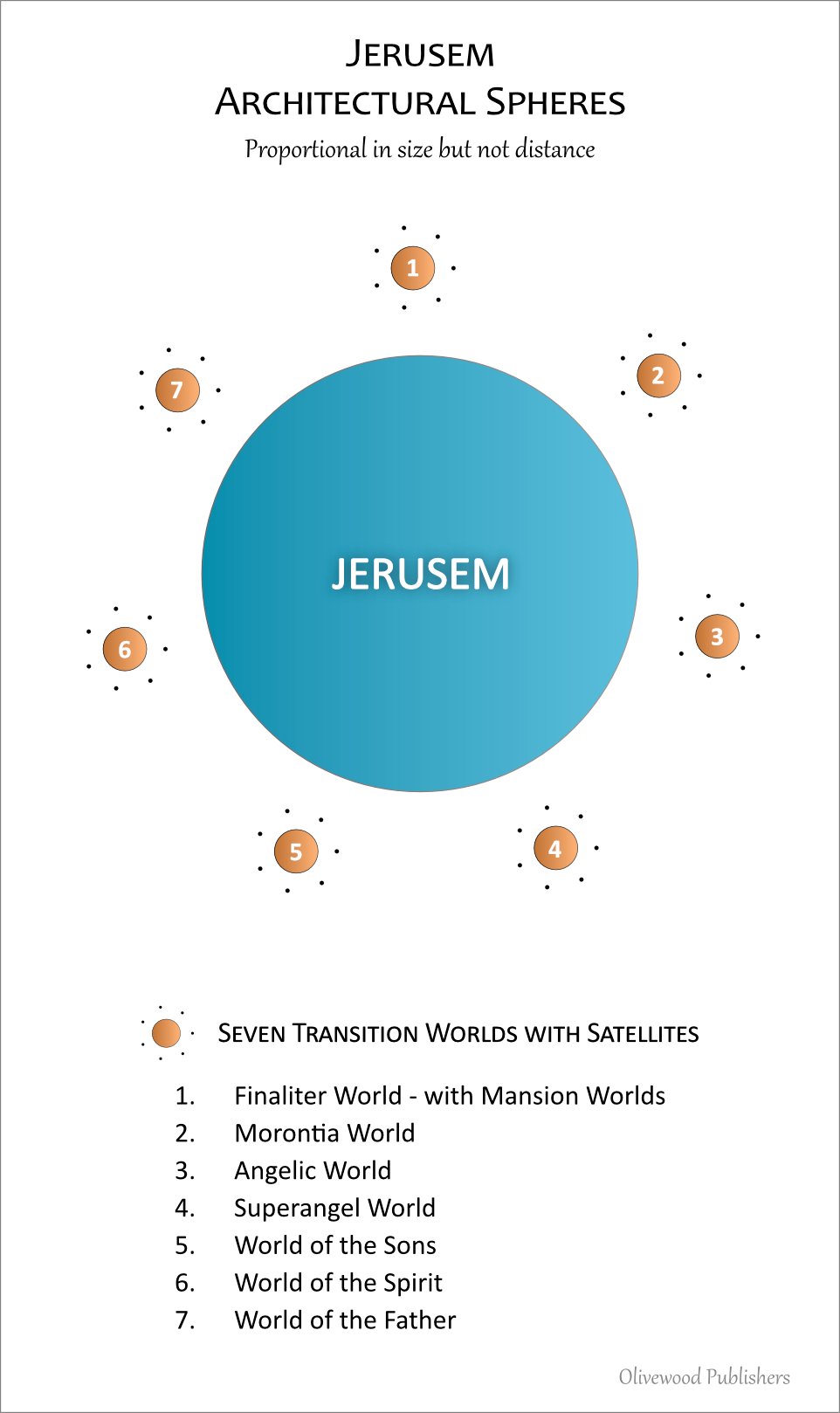
The world at the center of this system is Jerusem, and surrounding it are seven smaller worlds called transition worlds. And circling each of these transition worlds are seven smaller satellite worlds. Altogether, there are 56 of these morontia worlds surrounding Jerusem. Of these, The Urantia Book draws our attention to the seven satellite worlds surrounding transition world number one (see diagram). These seven satellites are exclusively referred to as the mansion worlds, and this is where our eternal journey resumes after we leave Urantia, our “initial-life” planet.

In my Father’s house are many mansions. ~ Jesus of Nazareth

Jerusem Transition Worlds

The mansion worlds are but a small part of the Jerusem system of architectural worlds. Jerusem itself is gigantic, about one hundred times the size of Urantia — almost the size of our sun. The transition worlds are smaller, about ten times the size of Earth, which is near the size of Saturn or Jupiter. And the mansion worlds, as well as all other satellites, are smaller still, approximately the size of our earth (45:0.1).

On Urantia, we mortals are all “ascension candidates,” which means that, if we choose to survive, we can eventually ascend all the way to Paradise. On this long journey, we start on the first mansion world — mansonia one. And depending on the level of achievement we reach on Urantia, we could soon be transferred to mansonia two or three, or even further up.

Our level of achievement is, to a great degree, determined by our individual attainment of the seven psychic circles (see 110:6), which are a measure of our spiritual and cosmic progress.

But this measure is somewhat ambiguous as only a few of the attributes and qualities that characterize each circle are mentioned in the book. Therefore, we really have no conclusive way to determine which circle any one of us may have attained.

These circles of mortal progression are levels of associated intellectual, social, spiritual, and cosmic-insight values. (49:6.8)

Nevertheless, we are encouraged by the fact that, if we attain the third psychic circle while on earth, or if we make the supreme decision to do the will of God, a personal guardian angel is assigned to us and, after death, we will be resurrected on the first mansion world on the third day. We all have guardian angels, but they are more often assigned to groups of individuals rather than exclusively to a single individual (113:1.0).

Those without a personal guardian angel become sleeping survivors, and their resurrection is delayed until the next planetary dispensation (see Paper 52) or, in some cases, at the call of special or millennial resurrections. The length of this delay varies from one millennium to fifty millennia. But it doesn’t make too much difference because, as a sleeping survivor, you are not aware of the passing of time. You will awaken as if it’s the next day. It’s also comforting to know there is no frenzied race to Paradise. However long it takes is not really a concern to God, nor should it be a concern to us. As Jesus said, “The important thing is not the rapidity of your progress but rather its certainty” (147:5.7).

Mansonia One

When we first awaken in the Temple of New Life on mansonia one, the change is sudden, and we will have trouble recalling our past (earthly) identity; our previous life seems like “a vague and hazy dream.” But thanks to the Thought Adjusters and guardian angels, we will slowly reconstruct the past.

Once resurrected, we start our new life exactly where we left off on earth. This means we not only reap the rewards of our diligent efforts to progress on Urantia, but we also carry with us any emotional baggage or imperfections of character. We will even speak our native tongue until we learn the language of Satania and, afterwards, the language of Nebadon (48:3.13). Fortunately, there will be many Morontia Companions to act as translators.

The morontia worlds are training spheres — places where we improve ourselves through education, practice, and experience. Most of our experiences on mansonia one will pertain to what is called “deficiency ministry.” This means we will be correcting “varied defects of creature character and deficiencies of mortal experience” (47:3.8). This includes, among many things, correcting defects “pertaining to sex life, family association, and parental function.” In other words, rather than learning more about universe relationships or cosmic meanings, as we do on succeeding mansion worlds, we will find ourselves actively engaged in a fundamental self-improvement program.

One of the purposes of the morontia career is to effect the permanent eradication from the mortal survivors of such animal vestigial traits as procrastination, equivocation, insincerity, problem avoidance, unfairness, and ease seeking. (48:5.8)

No doubt, coming from a world as troubled and confused as Urantia, it is quite likely that much improvement will be needed for most of us. But this is not entirely our fault. We can place much of the blame on the debilitating effects of the Lucifer rebellion, the consequences of which have greatly impeded world civilizations. As a result, almost all Urantians resurrecting on mansonia will find themselves at a distinct disadvantage. To all of us, the first mansion world will be an unfamiliar milieu — even alien, while those mortals coming from a “more normal” planet in the system will hardly notice the difference (47:3.1).

How critical are these differences? Considering that we are supposed to be living in a “Postbestowal Son Age,” they are probably much more striking than we can imagine at this time. A quick review of the social achievements associated with this age gives us some idea of how far adrift we are from the average planet.

Life on an inhabited world is so changed by rebellion that you can have little or no idea of such a regime on a normal planet. (52:2.1 emphasis added)

If you could be transplanted from your backward and confused world to some normal planet now in the postbestowal Son age, you would think you had been translated to the heaven of your traditions. You would hardly believe that you were observing the normal evolutionary workings of a mortal sphere of human habitation. (52:6.8)

In Urantia Book study sessions, some of us have speculated about which mansion world we will attain after resurrecting on mansonia one. Indeed, we have been tempted at times to believe we could skip to number two or three, or even four! But any honest consideration of our individual spiritual achievements, as well as the fact that we come from such a wayward world, should quickly dispel such lofty delusions. True, a few Urantians of “brilliant spiritual achievement” (e.g, Enoch and Elijah) have fused with their Thought Adjusters while on earth, so it is certainly possible to reach beyond the first mansion world. But I suspect most of us will be content to simply resurrect.

Once reborn on this alien world, we are given a new home and have ten days to adjust, perhaps longer. Our bodies will be of the lowest morontia form, almost material. In fact, we will continue to eat, drink, and rest throughout all seven mansion worlds. And as we will soon discover, we are no longer male or female, we are no longer sex creatures (150:1.3). Nonetheless, we retain our masculine and feminine “personality trends” all the way to Paradise (84:6.6).

In this new life, we might associate with the companions of our earth days and, no doubt, we will acquire new friends as well. But there will be no such thing as contractual marriage once we leave this planet (38:2.2). Even family relationships, while of paramount importance on earth, do not carry over to the mansion worlds (140:8.14).

No matter what our future relationships may be, it is unlikely we will be together all the time. Judging from the words of a Mighty Messenger, we could be separated from our closest companions “many times and for long periods” in our lengthy ascent to Havona (22:2.6). In other words, we will not live continuously hand-in-hand with any other being.

Mansonia Two and Three

On mansonia one, after ridding ourselves of all animalistic tendencies and defects, we continue our self-improvement program on mansonia two. This world has more to do with improving social relations and developing the intellect. It is where we finally eliminate all intellectual conflict and mental disharmony, which I’m sure will come as a welcome relief to many.

But only when we reach mansonia three does our positive spiritual progress begin. This is the world of “great personal and social achievement.” This is where we will finally complete the seven “cosmic circles of intellectual achievement and spiritual attainment.” It is our “…real introduction to the intelligent comprehension of cosmic meanings and universe interrelationships” (47:5.3). Completing these circles while living on earth would be the equivalent of reaching circle number one. To put this in perspective, this is the level Jesus reached on Mount Hermon at the age of 31 (134:8.4).

Fortunately, the time we spend on the first three mansion worlds may not be too arduous. Not only will we have a new body free of all ailments, but also a greatly expanded spiritual nature and a greatly enhanced mind capable of understanding mota—the profound philosophical perspectives of morontia life.

In addition to this improved nature, we benefit from the personal guidance of the Morontia Companions and Mansion World Teachers, as well as “all orders of angels, from planetary helpers to supreme seraphim” (48:6.1). Considering how much we all fumbled through earthly life without the wise direction of either a Planetary Prince or a Material Son, I’m sure most of us will appreciate getting some wise and practical advice (although there is much good advice in The Urantia Book).

One of the most important objectives of our training on the mansion worlds is to complete “the unification of the evolving mortal personality” (43:8.4). And since this is the goal set before us, it is reasonable to assume that it is an important goal while living our mortal lives on Urantia. Indeed, the discussions of morontia life in Papers 47 and 48 serve as solid reminders of what we can do to progress on earth.

Our personal training on the mansion worlds includes developing a spiritual nature, parental attitudes, greater social skills, and a good sense of humor. We learn to be more faithful and cheerful, to persevere no matter what the circumstances, and we become truly selfless. Among many things, we will enjoy philosophical pursuits (mota), learning the lessons of history, and acquiring the skills needed for good life planning.

Along with all this comes a tremendously exciting adventure. Satania is an enormous system to explore. We will not be confined to the mansion worlds, nor are our experiences limited to these worlds. We will have recreation time to travel back and forth between all the worlds in our local system. These journeys to the other transition worlds introduce us to the finaliters, the seraphic hosts, and the Brilliant Evening Stars, as well as other superangels presently unrevealed to us. We will also meet the local universe Sons of God and the high personalities of the Infinite Spirit. And we will have the privilege to worship on the World of the Father (Transition World #7).

At first, our journeys will be somewhat limited. But as we advance from one mansion world to the next, further opportunities will arise. By the time we reach mansonia seven, almost all of Satania will be open to us. And throughout all this time, we will always have the pleasure of periodic visits to Jerusem, as well as being student visitors to all the inhabited planets in the system — except our own planet, Urantia (39:4.15).

All in all, I look forward to a vibrant and progressive morontia life—but I’m in no rush to get there. This mortal life is an important one with essential experiences that we will never be able to replicate later on. As a Melchizedek reminds us, this is where we begin to live the way of God:

It is not so much what you learn in this first life; it is the experience of living this life that is important. Even the work of this world, paramount though it is, is not nearly so important as the way in which you do this work. (39:4.13)

anxious Urantia

Are Things Really Worse Than Ever Before?

It is difficult to escape anxiety and fear in the modern age. If we focus on the news of the world, Urantia appears forever in a state of chaos, with threats of war, a withering climate, oceans of plastic, corrupt governments, poverty, and racial strife.

We cannot deny the truth of these calamities. But the truth is often exaggerated. Despite all the doom and gloom, Urantia civilization continues to make significant advances. Granted, there has been much suffering along the way and we have a long way to go on the path to perfection, but we should at least recognize and celebrate the many achievements to date.

This positive trend is revealed in the data. A few pioneering publications on the topic are Factfulness by Hans Rosling (2018), Progress, Ten Reasons to Look Forward to the Future by Johan Norberg (2016), and Enlightenment Now by Steven Pinker (2019). These are far from being spiritual works, in fact, they are decidedly material and secular in their approach. Nonetheless, the empirical facts are there for all to see.

What these publications emphasize is that, in every major category, the world has improved. There has been a significant reduction in poverty worldwide, birth rates are dropping, education for girls is almost universal, deaths from accidents and natural disasters have dropped dramatically, life expectancies have increased worldwide, hunger and starvation is almost eliminated, and infrastructure greatly improved in all countries. The facts and figures clearly demonstrate that a lot has been accomplished, and it’s likely that much credit is due the Most Highs and the seraphim.

The Most Highs rule in the kingdoms of men through many celestial forces and agencies, but chiefly through the ministry of seraphim. (114:0.1)

The rule of the Most Highs, … is a rule designed to foster the greatest good to the greatest number of all men and for the greatest length of time. (134:5.4)

Hans Rosling’s website tests our knowledge with a number of simple quiz questions about the state of the world and finds that, in almost every country, most people get them wrong—they consistently select the most negative answers. There are a number of reasons why we are reluctant to accept the encouraging facts, an ailment he calls “the negativity instinct.”

Chief among the causes is the news media, which should come as no surprise. In a world motivated by profit, there is little money in good news, and the result is a barrage of terrible news, a relentless stream of horror and negativity. It’s no wonder the only future that many can imagine is a terrifying and dysfunctional dystopia.

Anxiety must be abandoned. The disappointments hardest to bear are those which never come. (48:7.21)

Despite the exaggerated troubles around the world, those of us saved by the truth of The Urantia Book have no such worries about the future of this planet, no matter what happens. Not only do we have the comforting words of our Creator Son, but in our personal spiritual journeys, we have our Thought Adjusters, the Spirit of Truth, and our guardian angels to guide us faithfully along the spirit path. And in the worldly realms, we have the Most Highs, the Melchizedeks, and the master seraphim. These spirit forces work relentlessly to improve civilization on Urantia. And they are having considerable success.

Coupled with our ignorance (or avoidance) of the facts, is our limited viewpoint. It is difficult for us to envision a positive and progressive evolution if we insist on viewing world events from a single lifetime. The truth is revealed in the big picture; the long-term history of events. Recall that before we leave our system capital of Jerusem, we will be “…quite familiar with the history of Satania and its 619 inhabited worlds” (48:6.31). Clearly, history is important, not just on this planet, but on the worlds to come. It is a factor of cosmic wisdom just as much as personal knowledge, life experiences, and insights are factors of worldly wisdom.

There are many good reasons for students of The Urantia Book to remain positive—to maintain a steadfast faith in the goodness and love of God.

Urantia is now quivering on the very brink of one of its most amazing and enthralling epochs of social readjustment, moral quickening, and spiritual enlightenment. (195:9:2)

…mankind is on the march toward higher evolutionary destinies. (71:8.15)

He [Jesus] sought to make it clear that the world is not to be regarded as an enemy; that the circumstances of life constitute a divine dispensation working along with the children of God. (140:8.3)

With improved media technology comes increasing exposure to the sufferings and troubles of the world, which is almost the entire focus of the news media. Therefore, keeping a balanced outlook requires making critical assessments. As Rosling says, “Things can be both better and bad.” We should put progress into perspective by looking at how much has been achieved while not losing sight of what more can be attained.

…be not mindful of those things which foster your anxiety, but rather at all times concern yourselves only with doing the will of the Father who is in heaven. (137:1.6)

Any portrayal of fear or anxiety on our part is but a reflection of our lack of faith in God’s divine dispensation. It also greatly diminishes any of our personal work to uplift the spiritual experiences of the individual. There will always be great challenges to improve the world, and it’s a sad fact that many suffer needlessly in life. Most of us want to change life on Urantia as best we can — we want to advance toward an age of light and life. But in God’s great scheme of things, we must trust Jesus. In the long run, there is nothing to worry about.

What he [Jesus] preached against was not forethought but anxiety, worry. (140:8.3)

Back To Top
midwayer.com