Skip to content

Posts appearing in 2nd home page grid

The soul

Your Spiritualizing Self

The soul has long been recognized as a spiritual component of human life. Indeed, all major religions acknowledge the concept of a soul, which is often defined as an immaterial essence or the animating principle of an individual’s life. But these are hazy concepts that say little about the true nature of the soul.

One of the most important things to know about the soul is that it is partly your own creation—it is your spiritualizing self. Just as you have a material body (your physical self) and a mind (your intellectual self), you also have a spiritual counterpart. The soul originates from the spirit potential of your mind, eventually emerging as a separate entity—an act of personal creation.

But this creation is not yours alone. Indeed, without the Spirit of God within you, your soul would not exist. Whenever you (personality) make a moral decision that is consistent with the Spirit Way—the guidance of your Spirit—you foster and further the growth of your soul.

Your Spirit Teacher is continuously attempting to spiritualize your mind, to adjust your thoughts and, thereby, foster a new being—a spirit complement—essentially a new you that can survive death. In truth, your soul is your immortal self.

From its earliest inception the soul is real; it has cosmic survival qualities.

– The Urantia Book (16.9.2)

When we speak of body, mind, and spirit, the spirit part of us is the soul. But this is not the same entity as the inner Spirit, which is the presence of God. Nor is the soul the personality, although personality encompasses the soul.

The soul is semi-spiritual and alive. It’s a growing spirit body that intervenes between physical reality and the spiritual level of existence. Scientific inquiry and philosophical discourse cannot prove the existence of the soul but, as a morally conscious individual, you can discover it through your own spiritual experiences.

Most of us go through life unaware of the presence of our souls. But that’s primarily because the soul is always with us, an integral part of us. We are so accustomed to its presence that we fail to see it as a separate, progressing, spiritual self. But as we advance in spiritual perception, we become more aware of its distinct character.

Essentially, the degree of our spirituality is correlated with the degree of our soul consciousness. And as our soul evolves, we begin to feel an overwhelming urge to contact the Divine Presence within us.

The Soul Grows

The creation of your individual soul, as well as its continuing existence, depends on your moral (spiritual) choices. The soul is born when you make your first moral choice—one that denotes your capacity to determine right from wrong. It is a joint creation between you and God.

Moral choice and spiritual attainment, the ability to know God and the urge to be like him, are the characteristics of the soul.

– The Urantia Book (133.6.5)

The creation of the soul in this way inspired the prophets of old to declare that we truly are children of God, true sons and daughters of a Creator Spirit. And if we accept our spiritual origins in both personality and soul, it logically follows that we are all spiritual brothers and sisters.

The soul, once created, does not remain static for our entire lives—it continually evolves as we make spiritually progressive choices. Metaphorically, the soul grows just as the material body grows, or as the mind grows in intellect and wisdom. The body grows when it is nurtured and exercised, as does the mind. The spiritual self is no exception in this regard—the more we nurture it and the more we exercise it with moral decisions, the more it progresses in both quality and quantity.

Whenever we make a decision that agrees with the Way of God, we nurture the evolution of our soul. Whenever we help others in any way, such spiritual activity exercises our soul with love. The process of soul growth is one of harmonizing our choices with the Spirit Power within us, thereby making an eternal alliance with this gift of God.

The evolving soul is not made divine by what it does, but by what it strives to do.

– The Urantia Book (48.7.24)

The Soul Reflects

The soul is self-reflective—a uniquely human trait. Self-reflection differs from the self-consciousness of personality. While self-consciousness provides us with self-awareness and an awareness of other selves, the self-reflection of the soul enables us to examine and evaluate ourselves, thereby objectifying our thoughts, feelings, and actions. It’s the ability to examine ourselves at arm’s length—to be morally mindful.

The soul is the self-reflective, truth-discerning, and spirit-perceiving part of man which forever elevates the human being above the level of the animal world.

– The Urantia Book (133.6.5)

Being morally mindful is being morally self-conscious, which requires courageous and sincere self-reflection. This is an essential meditative exercise for discerning moral implications and choosing divine values. This leads to progressive soul growth and an increasingly spiritual life.

When aided by the Spirit of Truth, all reflective thought of a spiritual or moral nature helps us to discern truth in any situation and is, therefore, always linked to wisdom. The ongoing process of self-reflection and moral choosing, when done in harmony with the Way of God, opens a spiritual channel that increases the amount of divine love, wisdom, and energy we can receive. 

The Soul Survives

The soul is your celestial shuttle to eternal life—your living connection to the spirit world. As we all surmise, the material body and the material brain do not survive death. But as many spiritual and religious visionaries have taught over the ages, the soul does.

The spiritual self (soul) survives death simply because it is not material, and also because it has an eternal purpose; namely, that the soul, along with the personality, goes on to form the nucleus of our new, immortal selves.

The soil of the evolving soul is human and material, but the destiny of this combined creature of mind and spirit is spiritual and divine.

– The Urantia Book (156.5.2)

Whether or not you choose life after death is your own prerogative. But one thing is certain—without a developed soul, there will be nothing of you to resurrect on the worlds to come. And even if you do possess a mature soul, you can still choose not to go on. If you do not wish to survive, your personal identity will simply dissolve in the great pool of universe energy. However, if you choose to move forward, you can fully anticipate an amazing life of eternal wonder!

But don’t expect your new life to be a bed of ease. You start just where you left off. There is no jumping the queue. All that we achieve in this life or the next will be through our own efforts and experience, not by some magical transformation into a perfect being.

A complaining soul complains even in Paradise.

Baha’u’llah

Nothing is more important for the moment than what you can accomplish in this life and on this world. Wherever and whenever you are, nothing is more important than how you live your life at any given moment.

faith

Have Faith in What?

We often think of faith as religious doctrine—the beliefs, rules, and rituals associated with organized religions, such as Christianity, Islam, or Buddhism. The same could be said for the many different branches or sects of these religions, such as the Catholic, Sunni, or Theravāda faiths.

When used in this way, faith defines a system of religious rules, ideologies, and traditions. If we wish to affiliate with any particular religious group, we are expected to believe what they believe and to do what they do.

But when faith is defined (or confined) this way, it is not spiritually productive. Whenever we accept dogmatic teaching as the whole truth, it can inhibit our spiritual sensitivities and restrict our thinking. In effect, it shatters any hope of discovering deeper spiritual meanings.

Modern religion finds it difficult to adjust its attitude toward the rapidly shifting social changes only because it has permitted itself to become so thoroughly traditionalized, dogmatized, and institutionalized.

– The Urantia Book (99.2.6)

Faith Is Confidence

Faith is better defined as simply having complete confidence or trust in someone or something. It is a firm belief in something for which there may be no empirical or objective proof. For instance, we could have resolute faith in the triumph of science, or persistent faith that our sports team will win. We cannot prove an event will occur, or that some spiritual force will act on our behalf, but we have unequivocal faith that it will.

When my son was just a toddler, he wanted to climb onto the mantelpiece above the fireplace (when houses had fireplaces). Cautiously, I stood him up on the shelf. He looked at me with a big smile and then, bursting into a laugh, he jumped from the ledge and flew right at me with his arms wide open. I was stunned for an instant, but caught him midair.

leap of faith
Image by beasterchen

This was a turning point in my grasp of faith. I realized that my son’s complete trust in me—his unwavering faith that I would catch him safely in my arms—is the same trusting faith I have in the eternal love and infinite goodness of our heavenly Father. This is the uninhibited and courageous leap of faith, one completely free of religious doctrine.

The faith of a trusting child is an essential attitude of mind simply because it opens our consciousness to receiving the spiritual gifts of God. Accepting and believing that we truly are spiritual sons and daughters of God underscores our sincerity and trust in the loving support and divine guidance of a caring universe. I cannot begin to over-emphasize the spiritual importance of such trusting faith.

Faith is a living, daring confidence in God’s grace, so sure and certain that a man could stake his life on it a thousand times.

– Martin Luther

It is easy to dismiss faith as false hope or a belief in fantasy, but everyone believes in something—everyone has faith in something—otherwise we could not begin to function in the world. We all operate within an ideological framework we accept as true, and we all have strong convictions about the true nature of reality, with or without proof.

If you are an atheist, you have faith that there is no Deity, although you cannot prove it. If you are a humanist, you have faith in the inherent goodness of humanity, but you cannot prove it. And if you are a materialist, you have faith that all reality is material in nature, but you cannot prove it. You can have faith in anything you choose, so what will you choose?

Having faith in God means we choose to trust the eternal goodness, infinite love, and wise counsel of the holy Presence within us. We have faith that God will always help in the long run, even if it may not appear so from our limited viewpoints, and even if we are not consciously aware of that help. Despite all obstacles and challenges, we persevere with courageous faith in our divine destiny.

While having faith requires no empirical or objective proof, the outcome of faith is firmly bolstered with subjective proof. In other words, the evidence of the power of faith can be observed in our personal spiritual experiences and in our improving relationships with others. We can never prove these inner experiences to others, but we know them to be true.

For those with faith, no evidence is necessary; for those without it, no evidence will suffice.

– Thomas Aquinas

The confidence of spiritual faith is a personal experience best described as a positive and trusting attitude toward divinity. Instead of a creedal formula or a set of principles, faith becomes a frame of mind in which we place enduring trust in the existence of spirit life, one coupled with our strong conviction about the goodness, wisdom, and love of God.

Faith Is a Psychological Technique

Just as there are natural laws of science, there are supernatural laws of the Spirit. One of these immutable laws is that neither God nor any of his celestial assistants will ever try to change or re-create you without your explicit consent. The Creator of a universe wants you to come to him—but only if you want to come of your own free will.

The Creator refuses to coerce or compel the submission of the spiritual free wills of his material creatures.

– The Urantia Book (1.1.2)

It is therefore almost impossible for spiritual forces to help a doubting and reluctant mind. The crucial point about faith is that God and his angels function more effectively through a believing and willing mind. When we freely believe in the truth about God, when we have complete faith in his love and help, we fully enable spiritual forces to take an active role in our lives.

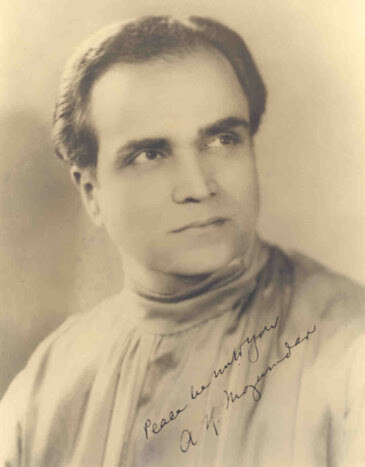
Imagine, accept, and believe that God is helping you.

– A. K. Mozumdar
have faith
A.K. Mozumdar

Faith is a psychological technique that takes us to the border of God consciousness and then empowers us to enter that domain. It’s a method used to reach beyond the limitations of reason and logic. Moreover, it’s a way of harmonizing our thoughts and behavior with divine truth, even if we cannot fully comprehend it.

Spiritual faith extends beyond any belief about the nature of material reality because humanity’s ideas about this vast universe are circumscribed and constantly evolving, just as scientific knowledge, social policies, and governments are evolving. In the 17th century, Galileo shocked the existing religious order because he contradicted their beliefs about the nature of reality—namely that the earth revolved around the sun—that it was not the center of the universe.

Faith, therefore, is more reliably based on supreme values and divine ideals rather than religious doctrines or fixed views about the nature of physical reality. Whenever religious beliefs become grounded in perceived material realities or fixed philosophical ideas, they stagnate, whereas faith in divine love is alive, vibrant, evolving, and adaptable.

Faith is the complete reliance on the power and goodness of Spirit and the firm belief that you’re always connected to this goodness.

– Wayne Dyer

Our faith in the goodness and wisdom of an infinite and eternal Creator works for the better because, in all truth, God is always good and perfectly wise. For all who have experienced the presence of God in their lives, he is real, even a fact. Although our minds cannot begin to grasp the full magnitude and magnificence of this First Source, we maintain faith in the oversight of a loving, friendly, and caring Creator who always urges us to be the best we can be.

Our spiritual thoughts and ideals cannot rise any higher than what we can imagine. Such faithful imaginings not only heighten our spiritual awareness but also become our spiritual compass, the inspiration that invariably points us in the right direction, forever enticing us to forge ahead—to achieve more in life. What a tragedy to limit our hopes and dreams to the dark confines of a cold, empty, and godless materialism. It’s no wonder so many good people imagine the future as a bleak and hopeless dystopia.

Humble and positive faith is a tool of consciousness; a necessary spiritual attitude for opening the door to the Divine Presence within you. It allows the Spirit to release its beneficial and dynamic superhuman activities into your consciousness. It is a positive and faithful attitude of mind that enables God to spiritually transform you.

Faith Is a Bridge

Faith creates a celestial bridge between the material mind and the spirit phase of existence. This bridge of faith is vital to spiritual progress because there is so much about spiritual reality and divine nature that the human mind simply cannot grasp with analytical reason alone. Our material thoughts lead us right up to the door of the spirit dimension, but from that point forward, it’s our spiritualized channels of thought, as defined by our faith and as adjusted by the Divine Presence within, that lead us Godward.

faith is a bridge
Image by James DeMers

Faith is a bridge to spiritual insight. We discern outward beauty with the physical senses, and we discern truth with the intellect. But only with spiritual insight can we begin to fully grasp divine realities. Having faith in the goodness of our Creator, which is an absolute truth, allows us to enter the reality of the spirit realm despite the intellectual limitations of the mind. It’s our ticket to divinity.

Faith is to believe what you do not see; the reward of this faith is to see what you believe.

– Augustine of Hippo

It’s what we believe rather than what we know that determines what we can achieve in life. All the knowledge in the universe will not necessarily make us happy, nor help us to progress in the spirit. But the good news is that faith can do these things because it reaches beyond knowledge and embraces spiritual realities we may not (as yet) comprehend.

The humble attitude of a faithful mind is at the heart of spiritual progress. It is the supernal approach to the magnificence and glory of an eternal and infinite God.

Living Faith

Faith begins with our unwavering conviction about the goodness, wisdom, and love of God. But genuine faith goes one step further. For faith to reach its full potential of bridging the gap between the material and spiritual worlds and thereby transforming our lives in the process, we must live our faith.

However many holy words you read, however many you speak, what good will they do you if you do not act on them?

– Buddha

The spiritual truths gained through faith become a reality in our lives as soon as we begin to practice them. The whole notion of living faith is living a life in the spirit eagerly and happily. It’s living a life dedicated to the divine ideals and supreme values we so ardently profess to believe.

It’s impossible to achieve spiritual harmony and divine unity through mind alone. Even though meditation and prayer are excellent ways to enhance spiritual perception and contact divinity, they are not enough by themselves. Only by acting out our faith in all sincerity can we coordinate and unite the energies of body, mind, and spirit. By acting out our faith, we actualize it—we make it a reality within ourselves.

Living our faith is a divine privilege. It’s a happy endeavor done with enthusiasm and love; it’s meeting daily challenges with vigor and inspiration; it’s remaining undaunted in the face of all disappointments and failures; and it’s cultivating an indomitable spirit that perseveres regardless of life’s difficulties and despite all worldly strife.

Religious Zealots and Politics

Having The Urantia Book to guide us through life is a blessing indeed. It’s an inside track to the truth, not just about God and the teachings of Jesus, but also about the nature of religion, spirituality, society, politics, history, and much more. Many of us, as we begin to grasp these truths, become fired up with the zeal of the newly converted, feeling a strong impulse to sing the praises of the revelation to all we meet.

This is a good thing, but only as long as we keep ourselves in check and balance. It’s easy to give unwanted advice or to tell others what they should think and how they should live. Any such notion of moral superiority is a dangerous quagmire, and nowhere is this more evident than in politics.

For most of human history, religion and politics were inseparable. The earliest records began with the Sumerian city-states around 5,000 years ago. Each of these city-states had its own temple dedicated to a patron god or goddess. And when they fought each other, one important objective was to raid the enemy’s temple to seize their idols, which would make their victory complete.

It was common for conquering tribes or nations to claim religious superiority by building their own sacred buildings over those of their ideological enemies. Early Christians, for example, built their first churches over the remains of Greek and Roman temples. Later, conquering Muslims constructed mosques over non-Islamic places of worship; for instance, the Hagia Sophia of Turkiye was once a Byzantine Christian church. In recent times, Hindu nationalists destroyed a historic mosque in the northern city of Ayodhya, India, and then built a Hindu temple over the ruins. This human inclination to obliterate the politico-religious foundations of perceived adversaries runs throughout history.

But it was not enough to destroy a foe’s temples. A prime objective of many conquerors was to convert their foes to their religion by whatever means necessary. In ancient Judea, the Maccabees under the leadership of John Hyrcanus I (134-104 BC), forcibly converted neighboring populations to Judaism. Another example is Emperor Charlemagne (748-814), who was the first ruler to unite West and Central Europe. Many of his social and political policies were vast improvements that had a lasting influence on European civilizations. But he was adamant that all his subjects become Christian, or be put to the sword. And during the religious wars of the Crusades (1095 to 1291), Christians and Muslims alike forcibly converted their captors.

Many deeply religious people have a hard time tolerating the beliefs of others. But this human urge to convert others to their beliefs is not limited to religion. While intolerance is often associated with religious views, it is a matter of historical record that humanity has suffered far more death and destruction through endless clashes between conflicting political and economic ideologies. Take, for instance, the long wars fought between liberalism and authoritarianism, or those between capitalism and communism. Other instances include wars over land and resources, as well as colonialism and the right to rule.

The evidence for this is laid out in the Encyclopedia of Wars by Charles Phillips and Alan Axelrod (2004). They report that less than 7 percent of all recorded wars were religious wars. And the casualties from these wars account for less than 4 percent of all war casualties.

Is Jesus on Your Side?

It’s not unusual in times of political turmoil to hear religious people of all stripes espouse partisan views that, they believe, can be justified in the name of God, Allah, or Ram, or their sacred scriptures. Even Jesus has been dragged into the fray. But what would Jesus say about our present politics? Probably not much.

Jesus once expressed his political ideas and ideals when he lived with the Zebedee family (129.1.10), but after that, he said little (as revealed to us). The only other time he discussed politics at length was when he delivered the Urmia lectures. But these discourses consisted of very general topics, such as political sovereignty, political power, and political evolution (134.5.0). Nonetheless, he did advocate representative (democratic) governments and the need for world government.

But when it comes to more specific stances on politics or his political preferences, it is clear that Jesus did not express any view, nor did he take sides, at least nothing he was willing to share with his apostles or disciples. He kept quiet on this topic for good reason. If he had taken any side or formulated any view at all, you can be sure that it would later become a dogmatic position of his followers, thereby interfering with the natural political evolution of humanity.

And if Jesus were on earth today, living his life in the flesh, he would be a great disappointment to the majority of good men and women for the simple reason that he would not take sides in present-day political, social, or economic disputes. (140:8.16)

Jesus’ mission was purely spiritual. He wanted the people of Urantia to become more aware of the true nature of God and thereby inspire them to follow the guidance of the Spirit within. Jesus knew that, by increasing God-consciousness in the minds of men and women, he would enable them to solve their political and social problems for themselves.

It is not the will of the Father that I should yield to the temptation to teach you rules of government, trade, or social behavior, which, while they might be good for today, would be far from suitable for the society of another age. I am on earth solely to comfort the minds, liberate the spirits, and save the souls of men. (140.6.6)

Knowing the mission of Jesus, we may wonder what role we should play in this time of social conflict. It seems there is no simple answer. Much depends on whether we wish to be a gospel messenger, a disciple, a follower, or a politician. As Jesus said, if we wish to serve God as ordained ministers, we must be willing to forsake all. There can be no divided affections (163:2.3). He therefore instructed his disciples to remain politically aloof.

But not all of us are required to be religious leaders or disciples. Many who are spiritually inspired are merely good citizens, perhaps engaged in other important social, artistic, or industrial endeavors, and a few of us are politicians. Indeed, rather than avoiding politics, The Urantia Book makes it clear that political service is highly desirable.  

In advanced states, political service is esteemed as the highest devotion of the citizenry. (71:3.12)

It is also clear in the same paragraph that politicians and civil servants are in categories apart from religious leaders. It seems we must choose between political service and spiritual service.

One of the great peace moves of the ages has been the attempt to separate church and state. (70:1.14)

Does the separation of church and state mean that our spiritual views should never interfere with our political duties? Once again, there is no black-or-white answer. Carrying out our political duties in a reasonable manner while dedicating our personal lives to the will of God is an acceptable way to function. But we would err if our duties are swayed, for example, by the belief that certain political leaders are of divine origin or that, long ago, God jotted down all the social and political rules for us to obey.

Sacred Government

While Jesus left us to our own political devices, The Urantia Book has much to say on the topic. Why does the book go into so much detail and give us so much political advice when Jesus avoided it? We can only assume the book is intended for a specific time frame of social and spiritual evolution, and that in this time, Urantia civilization is in great need of change.

One important point that the narrators emphasize is the spiritual aspect of government. The division of government into executive, legislative, and judicial functions is a divine administrative structure. This is the way “celestial politicians” administer the whole universe. But apart from these sacred divisions, all else is experiential and evolutionary on the inhabited worlds.

The only sacred feature of any human government is the division of statehood into the three domains of executive, legislative, and judicial functions. (71:8.1)

Papers 70 to 72 offer many ideas to improve our present society and government. However, the narrators never tell us what we should do at any particular moment. They are only offering guidelines for the future evolution of an ideal representative government. They are offering ideas and policies that we can strive to implement in the near future. And of course, we can compare their suggestions to our present state of politics to get some idea of how far astray we may be.

But are the people of the world (or even Urantia Book students) ready to accept all recommendations in the book? If we truly believe that the suggestions in these papers are Deity-approved instructions and procedures for improving our politics and society, then we should dutifully accept them all as the will of God (at least for this dispensation). However, acceptance is easier said than done. It is a troubling fact that many of the directives put forward in the book are far more draconian than most people of Urantia are willing to tolerate at this time, and perhaps for some time to come. As a striking example, see Paper 72, “Dealing with Crime.”

It is tempting to “cherry pick” specific ideas from the book—especially those that support our cherished political beliefs—and to ignore (or misread) those that do not. This selective choosing of “truths” conflicts with the whole truth of the revelation, and this alone should drive home the point that what we strongly believe—our ingrained social mores and political views—may have little or nothing to do with the will of God. Instead, such notions may prove detrimental to the progressive evolution of politics and society as per the divine plan.

When it comes to politics and points of view, we must ask ourselves if we have the spiritual courage to accept the entire revelation, no matter how unpalatable to current tastes some suggestions may be.

The Role of the Most Highs

We know that Jesus does not interfere in our politics, but we also know that the Most Highs certainly do. The question is, how do they interfere? Because they “rule in the nations of men,” have they ordained certain people as government leaders, the chosen of God, as it were? No mortal knows for sure, but there may be some truth to this.

The Most High rules in the kingdom of men and gives it to whomsoever he will. (43:3.4)

Nevertheless, we should recall that the Most Highs are not concerned with individuals but rather with races of people, with national groups, and with the whole of humanity. As Jesus said in Urmia:

This rule of the Most Highs in the kingdoms of men is not for the especial benefit of any especially favored group of mortals. There is no such thing as a “chosen people.” The rule of the Most Highs, the overcontrollers of political evolution, is a rule designed to foster the greatest good to the greatest number of all men and for the greatest length of time. (134:5.4)

The objective of the Most Highs is the greater good of the whole of humanity, not one nation, and certainly not one individual. But a sobering thought is the obvious fact that these Vorondadek Sons are not necessarily interested in stopping wars, correcting injustices, or preventing human suffering, at least not in the short term. And in the interim, they appear to give us enough rope to hang ourselves.

Even so, if we are willing to accept the argument that the Most Highs choose our rulers, we have to wonder why they would have sanctioned the likes of Adolf Hitler, Joseph Stalin, Idi Amin, or Attila the Hun. And these are just a few. There are many horrifying accounts of notorious leaders in the long stretch of world history.

If indeed the Most Highs sanction such rulers in “the kingdoms of men,” one possible explanation is that they allow such tyrants to rise to power so that, through much suffering, we will finally come to realize that we cannot allow such tyrants to rise to power. And if we, the people, continue to ignore the horrific lessons of history, then we must repeat them one more time until we get it right.

No state can transcend the moral values of its citizenry as exemplified in their chosen leaders. Ignorance and selfishness will insure the downfall of even the highest type of government. (71:3.1)

Put another way, the above quote is saying that a nation and its leaders can’t be any better than the people who make it up. But this is true only in democracies. Unfortunately, in many countries, the people do not get to choose their leaders and they have little to do with government policies. Instead, these so-called leaders are nothing more than strongmen who have forcibly taken control—they are no more than crime bosses. And even in some democracies, leaders have been elected to office only to betray their citizens at a later date. This serves to underscore another recommendation in The Urantia Book — and that is to make sure we have qualified politicians who are “technically trained, intellectually competent, socially loyal, and morally fit” (71:2.19).

Pursuing Ideal Government

The Urantia Book makes our short-term political and social goals abundantly clear. If we are willing to couple these ideas with the leadings of the Spirit of Truth and the Spirit of God, we are sure to make progress, no matter how slow it may be. And if we are still unsure of the direction to take, we can always fall back on the divine realities of truth, beauty, and goodness. For all people, organizations, and nations, we ask: Are they truthful? Are they good? Are they gracious? Are they compassionate?

Jesus did not give us political guidance; our job is to figure it out for ourselves. The Urantia Book gives us some advice and direction, but a review of the ages of light and life (Paper 55) makes it clear that any political suggestions it has to offer are to improve our immediate politics—they are not for the ages of light and life in the far distant future.

While there is a divine and ideal form of government, such cannot be revealed but must be slowly and laboriously discovered by the men and women of each planet throughout the universes of time and space. (70:12.20)



Back To Top
midwayer.com